Welston Book Worms
April 2026
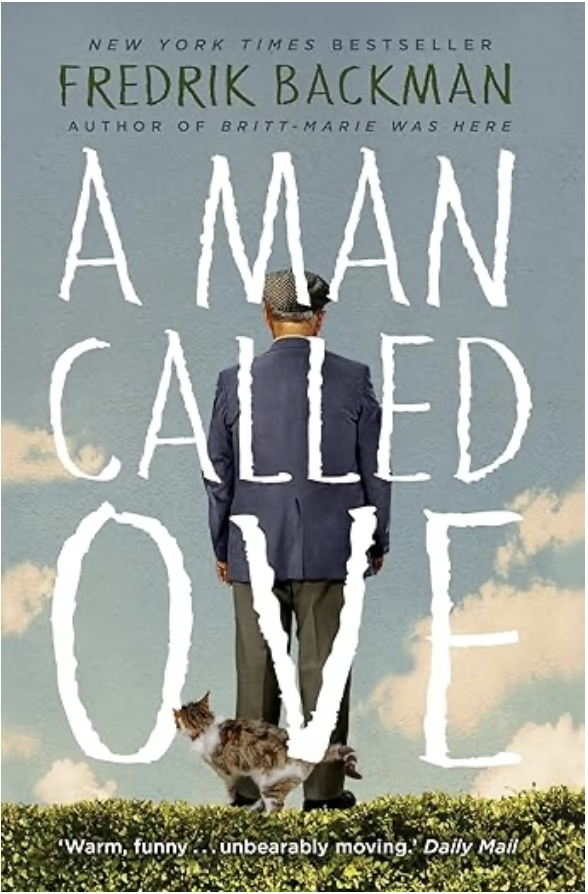
This month, the Welston Book Worms gathered at the Bookish Barista to discuss Fredrik Backman’s A Man Called Ove, a novel that—like most things chosen by Sonia Featherstone—arrived with the promise of order and promptly unravelled into something far more revealing.
Tea was poured, while a suspicious quantity of cakes, biscuits and pastries formed a diplomatic buffer in the centre of the table. As ever, we began with good intentions and ended somewhere between emotional disclosure and procedural combat.
Sonia opened proceedings by referencing the American film adaptation (A Man Called Otto, featuring Tom Hanks), noting—sensibly—that while the film had its merits, the book offered greater nuance.
Naturally, Constance Dilmore disagreed.
She found the novel predictable, its humour “telegraphed,” and accused it—rather bravely, given the company—of being ‘preachy.’ One suspected she’d have praised it as understated brilliance had Sonia taken the opposite view. Still, consistency has never been Constance’s burden.
Joe Halton then confirmed he had watched the film (on Netflix, no less), enjoyed it thoroughly, and—with admirable efficiency—considered his contribution complete. He turned to Alfred Bushwell as one might pass a baton.
Alfred, consulting notes that appeared to have been prepared for a symposium rather than a book club, spoke of generational disconnect. He reminded us—firmly—that fifty-nine is not old, and that Ove’s life, though marked by tragedy, demonstrated the quiet value older individuals continue to bring to their communities. It was, for a moment, a rather fine point.
Then Gerard Savin began to cry.
Not theatrically, you understand. Gerard doesn’t do theatre—he does feeling. With some encouragement (and back-patting) from Joe, he explained that Ove’s love for Sonja, and later his reluctant connection with his neighbours and a stray cat, had moved him deeply. For a moment, silence hung over the meeting.
Sonia, sensing a return to something resembling cohesion, began to share her own thoughts, at which point Eleanora Reingold intervened.
‘Members are not permitted to speak until all reviews have concluded,’ she announced, with the air of a woman who had both written and enforced the rulebook, whether or not anyone else had seen it.
Alfred chuckled at this and, with a timing that suggested either bravery or poor judgement, observed that Eleanora reminded him rather a lot of Ove: a stickler for rules. He then asked, quite plainly, why those rules mattered so much to her.
The room paused.
It was not the sort of question Alfred usually asked. We all felt a subtle but unmistakable shift.
Eleanora, to her credit, did not retreat behind procedure. She smiled and explained that, as a former chemistry teacher, rules had not been a preference but a necessity. Without them, a classroom of thirty restless pupils, Bunsen burners, and a cupboard full of volatile compounds would have been less an educational environment and more a controlled explosion waiting to happen.
Alfred gave a small, approving nod. ‘You’re a woman of hidden depths, Eleanora,’ he said.
She blushed. Then, quite unexpectedly, she giggled—once.
It was enough, and the tension broke.
In the end, opinions remained divided. Some found the novel deeply moving, others faintly manipulative, and at least one of us remained loyal to Tom Hanks. But A Man Called Ove, for all its brevity, carries a weight of themes—love, loss, friendship, resilience—that might well overwhelm a lesser story.
Backman, mercifully, keeps them in balance. The Book Worms, on the other hand, do not.
And that, I suspect, is why we keep coming back.