Welston Book Worms
August 2026
Alfred Bushwell played host in the Cosy Days Community Area, where Chef Rossi had laid on a cream tea so substantial, it made several of us reconsider our commitment to literary criticism. Sonia Featherstone, Constance Dilmore, Gerard Savin, Joe Halton, Eleanora Reingold and yours truly were in attendence.
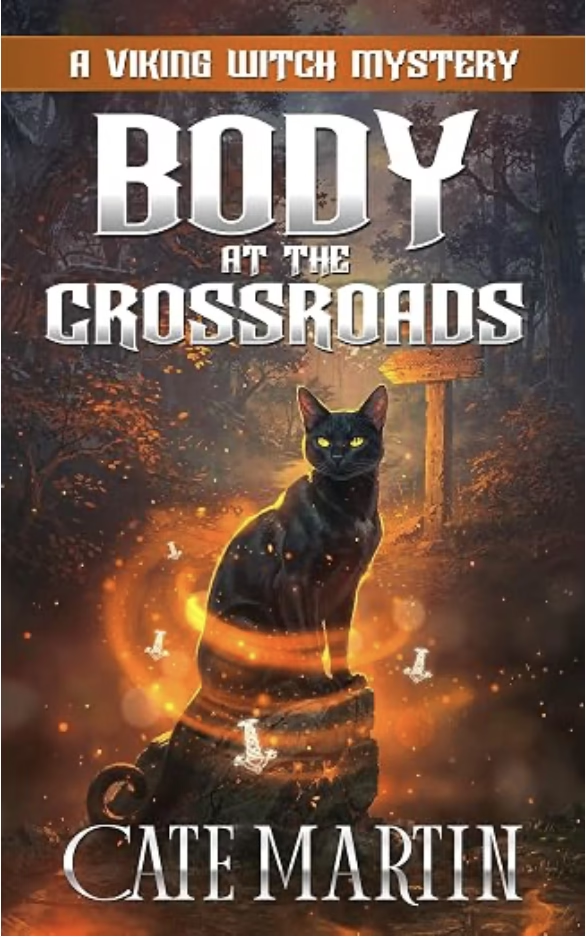
Constance chose this month’s book, Body at the Crossroads by Cate Martin, the first in a seventeen-book series, set partly in small-town Minnesota and partly in a hidden village of Viking descendants connected to it by magic. Ingrid Torfa, our heroine, returns home after her mother’s death, swerves to avoid a body in the road, and crashes into both a tree and her own forgotten inheritance.
Constance opened proceedings in a state we don’t often see her in: enthusiasm, undiluted. She praised the worldbuilding, the quiet magic threading the two towns together, and confessed—with something approaching shyness—that she has “a thing about Vikings.” Several of us exchanged glances, but none of us pursued it.
It was Sonia who, with the air of someone setting off a firework and only then reading the warning label, observed that as a mystery the book was rather light on twists and red herrings.
Constance, ready for this, explained that with seventeen books to build a world in, the first instalment could hardly be expected to do everything at once.
Then Alfred—looking remarkably well this evening, and, notably, working entirely from his own notes for the first time in some months—pointed out with characteristic precision that there had, in fact, only been one suspect with any real motive, and that the murder method itself had supplied the story’s sole twist. He wondered aloud whether one twist was quite enough to carry a whole mystery.
Constance said the twist was the perfect counterweight to the worldbuilding.
The room’s temperature plunged. Gerard shifted in his seat, squared his shoulders and announced he’d enjoyed the book enough to give the author the benefit of the doubt and read book two. Eleanora, who I fully expected to raise a point of order about the seventeen-book commitment this implied, said nothing of the sort and nodded along.
Sonia, perhaps sensing blood that nobody wanted spilled, turned to Joe Halton, who had been unusually silent throughout. A sheepish Joe admitted the book had inspired him to rewatch the entire Vikings television series, which had regrettably consumed every hour he might otherwise have spent reading it.
There was a pause. Then the whole table dissolved, Constance included, and for a moment it looked as though the afternoon might close on nothing worse than laughter.
Then the laughter faded, and so did Constance. She was quieter, a little smaller in her chair, the fight gone out of her. Sonia noticed and suggested that perhaps the Bookworms might return to the series in a few months and read book two together.
Eleanora’s hand went up. ‘It’s not,’ she began, ‘strictly within the chair’s remit to schedule future selections without—’
Sonia scowled at her. Eleanora looked at Constance and arrived at the same conclusion the rest of us had. She lowered her hand without finishing the sentence.
The group accepted Sonia’s suggestion unanimously, and Constance, visibly restored and already certain that book two would prove her right in ways book one hadn’t managed, agreed with the quiet dignity of a woman already rehearsing her vindication.
It was at precisely this moment that Chef Rossi reappeared bearing a fresh tray of scones, as though summoned by the sound of a book club being kind to one of its own.