
Welston Book Worms
June 2026
This month’s meeting of the Welston Book Worms took place among the crowded shelves and curious ornaments of Joe Halton’s antique shop, which, in hindsight, was perhaps not the wisest venue for discussing a Japanese mystery novel built entirely around unsettling images and hidden meanings.
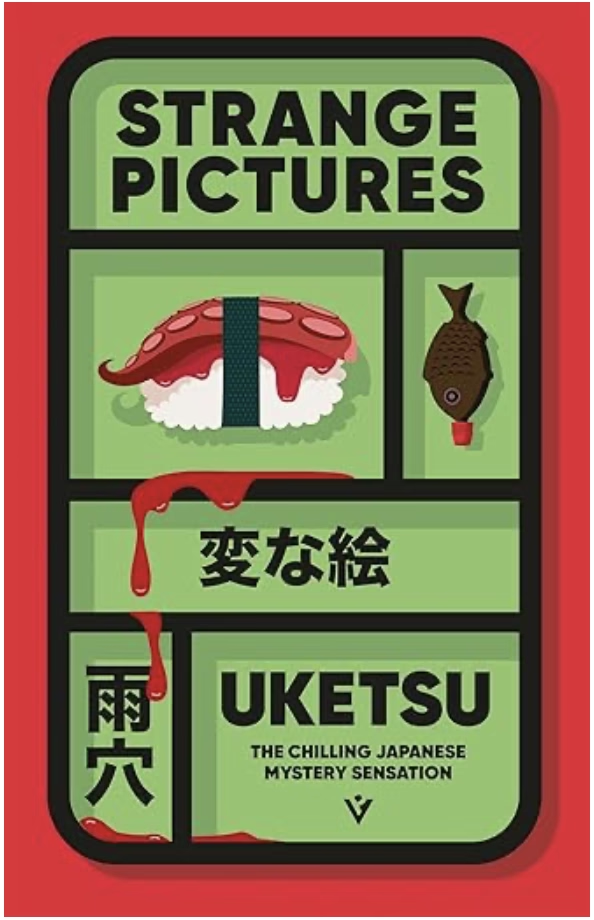
June’s book was Strange Pictures by Uketsu, a deeply unsettling mystery in which a series of seemingly innocent drawings conceal clues connected to murder, tragedy and secrets hidden in plain sight. Sonia Featherstone selected the novel in the hopeful belief that, for once, the group might reach a broad consensus beyond their usual arguments over pacing, symbolism and whether the television adaptation “completely missed the point.”
Initially, her gamble appeared to pay off.
Everyone agreed the book was creepy.
Unfortunately, Sonia then mentioned an article she had read in The Daily Telegraph describing Uketsu as “Japan’s answer to Richard Osman,” at which point the evening immediately split into several hostile factions.
Alfred Bushwell dismissed the comparison as “a symptom of modern journalism’s desperate need to flatten cultural nuance into something middle England can digest with a biscuit.” He later expanded his theory by arguing that the novel was, in fact, a social commentary on modern Japanese isolation and the psychological strain of conformity. Nobody directly challenged this interpretation, largely because nobody entirely understood it.
Joe, meanwhile, surprised everyone by not only reading the book from cover to cover, but thoroughly enjoying it. This led Gerard Savin to quietly suggest that Joe perhaps preferred the novel because it “contained pictures,” before asking whether he had mistakenly believed he was reading a graphic novel.
Joe denied this accusation with such force that several porcelain dogs rattled on a nearby shelf.
The discussion deteriorated further when Eleanora Reingold began analysing the illustrations as though they were mathematical proofs and accused Constance Dilmore of “skipping ahead emotionally” rather than following the evidence properly. Constance retaliated by claiming she had solved the mystery halfway through the book, although she declined to explain how.
As the evening progressed, the atmosphere inside the shop grew steadily more peculiar. Several members became distracted by Attila, Joe’s tiny taxidermy mouse, who sat on a wooden plinth holding a miniature beer and smoking a cigarette with the resigned expression of a commuter waiting for a late train to Croydon.
At some point during Alfred’s lecture on post-industrial alienation, Eleanora became convinced Attila had been moved three inches closer to the discussion table.
Joe denied touching him.
Constance claimed the mouse’s cigarette had been pointing towards the door earlier in the evening.
Gerard admitted he found Attila “unexpectedly sad.”
By this stage, Sonia had entirely lost control of the meeting and was reduced to repeatedly reminding members that the discussion was supposed to concern the book and not “the emotional intentions of a smoking mouse.”
Fortunately, salvation arrived shortly afterwards in the form of a large takeaway order from the Golden Phoenix. Peace was restored almost immediately once cartons of sweet and sour chicken, chow mein and prawn crackers began circulating around the room.
Even Attila, I noticed, appeared less threatening by the end of the evening.